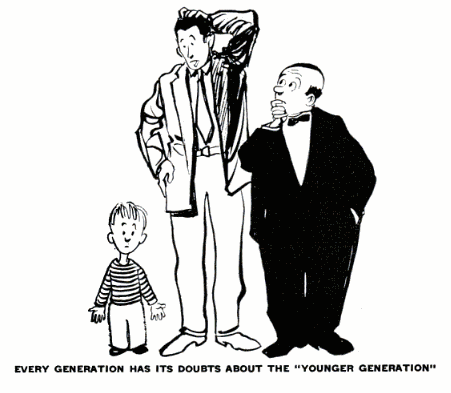
Are You Selling the Next Generation Short?

If you’re skeptical of the younger generation, their gadgets, technologies and liberties that you can’t imagine taking now, remember, you were once accused of the same thing.

The below article gives context for why we ALWAYS sell the next generation short. I’ve included one of my favorite quotes from the article that I would call a MUST-READ for perspective.

Simply put, many parents and cultural critics have passed through their “adventure window.” The willingness of humans to try new things and experiment with new forms of culture—our “adventure window”—fades rapidly after certain key points in life, as we gradually settle in our ways. The English satirist Douglas Adams put it this way: “Anything that is in the world when you’re born is normal and ordinary and is just a natural part of the way the world works. Anything that’s invented between when you’re fifteen and thirty-five is new and exciting and revolutionary and you can probably get a career in it. Anything invented after you’re thirty-five is against the natural order of things.”

Consequently, once their adventure window slams shut, many parents, policymakers, or social pundits convince themselves that “the good ‘ol days” are behind us and the current good-for-nothing generation and their new-fangled gadgets and culture are steering us straight into the moral abyss.

Why Do We Always Sell the Next Generation Short? – Forbes.

Share and Enjoy

  • Facebook
  • Twitter
  • Delicious
  • LinkedIn
  • StumbleUpon
  • Add to favorites
  • Email
  • RSS

10 Best Practices for Social Media Success

In my new job, I do a lot of research specifically on the 18-34 “Millennial” demographic. If you’re targeting the same demographic, you are well aware the social media is playing a strong roll in your strategies. The good news is, social media isn’t waning one bit. In fact, it’s on the rise. The question isn’t should you market in the social space, but how? eMarketer.com recently release an article that offered their 10 best practices for social media success. These are so good that I wanted to share them with you. My thoughts are [italicized]:

  1. Don’t think social media, think social marketing. – Social marketing is more about empowering, organizing and training select staff members to engage on social platforms—and building a corporate social presence—than it is about paid media placements.
  2. Know your objectives first—then develop your social strategy. – Broadly speaking, the most important objectives relate to creating deeper relationships with customers and branding.
  3. Recognize the secret ingredient: trust – Clearly, marketers see an opportunity to leverage this peer-to-peer trust factor by participating in and influencing social conversations taking place on the Web. But the way in which they do that is critical. The first step toward earning trust with consumers, as in any relationship, is to listen. [If you haven't read Chris Brogan's Trust Agents yet, do it soon.]
  4. Listening comes first. [When @ComcastCares entered the Twitter space, they did so by listening first. It wasn't until they understood the medium and how their customers were using it, that they actually went public. Planning and preparation are key to success in the social space.]
  5. Don’t just barge into a conversation: Add value. [In fact, nothing will get you ignored faster.]
  6. Be authentic, transparent and humble. [Social media is about conversation. It's not a platform.]
  7. Recruit from your core: the brand enthusiasts who already love you. – Digital communities allow marketers to both find these coveted consumers (through listening) and empower them to share a brand story with many others.
  8. Target the coveted influentials. – Some consumers have more clout than others. These so-called influentials, representing about 10% of the population, according to Keller Fay Group, have an undue influence on others because of their extensive digital networks and perceived expertise in particular areas. Keller Fay believes that influentials are 130% more likely than others to talk about brands on any given day.
  9. Adopt a long-term/real-time approach. As blogger and social media expert Joe Jaffe has frequently said, “[Social media] marketing is not campaign; it’s a commitment.”
  10. Integrate social media with other online and offline communications. Social media represents another stream of touchpoints for the marketer, but they are most valuable when integrated with other consumer activities, from search and e-mail to watching videos and reading news online.

Whether you are a brand, or someone trying to figure out how to engage with people inside the social media sphere, this is a great list to go by.

What are your social media best practices?

Share and Enjoy

  • Facebook
  • Twitter
  • Delicious
  • LinkedIn
  • StumbleUpon
  • Add to favorites
  • Email
  • RSS