How to Write a Strong Marketing Proposal

Writing a strong marketing proposal is key to winning new business. It is the point of reference that both you and your client will reference when there is a need to establish expectations, objectives and successes.

Over the years, I have written a lot of proposals. Some were really bad and some were great. In the past year or so, I’ve begun to hone in on what I believe to be a strong marketing proposal template. Since this is one of the keys to success, I thought I would share with you all how I write marketing proposals for my prospect clients.

Note: At the bottom of this post, you will find a Word template that you can download for your own use.

Step 1: The Overview

This purpose of the overview is to show your client that you understand the opportunity at-hand, the market conditions they are facing, and how you and/or your company can help them achieve the goals and objectives. Be careful to keep this section about the client, not you.

Step 2: Your Idea(s)

The next step is to write a summary about your campaign idea(s). You want to be careful to not reveal so much detail that they run with your idea and never hire you. You want them to see that you’ve given it some thought and you have a plan when they hire you.

Step 3: Prove Your Idea

In step three, provide the prospect client with statistics and research that backs up why you think your ideas are viable. In some cases, you may be able to provide insight into an area of opportunity that they never thought of, thus giving you a competitive edge.

Step 4: Objectives *

In step four, list out the objectives that you plan to achieve and when. For example:

  • Complete the 2011 marketing strategy and schedule within 30 days

This gives your client a list of deliverables and sets the expectations and benchmarks for success. It also empowers your client to keep you accountable for what you say you’ll deliver.

Step 5: Measurement of Results

In step five, you establish how you and the client will measure success. Be as specific as possible. For example:

  • Increase the number of unique visitors at the website by 10% within 90 days of the campaign launch

The temptation is not to be specific because nothing is guaranteed. However, establishing measurable results will build confidence in your client and give you and your team a scoreboard in which you can measure your own success.

Step 6: The Value to [Client Name]

In step six, you establish credibility with your clients. This is where you talk about your previous successes, your technological advances, best-practices and current and/or previous client accomplishments.

Step 7: Timing

In step seven, you estimate how long it will take for you to plan, execute and provide proper analysis of the idea(s) and when you can start on the project.

Step 8: Methodology & Options

One of the keys to a marketing proposal is providing options to your client. If you only give them one, they will see your proposal as take-it-or-leave-it proposal. That will leave you clientless in a heartbeat. However, providing them options empowers them to decide how they will use you based on their needs, not yours. Here are the options that I generally provide to my clients:

  1. Advisory – In this role, you typically serve in a short-term capacity. Perhaps, three to six months. Your aim is to establish the campaign plan, strategy and analytics, then empower their team to execute.
  2. Consultative – In this option, you do everything that you would have done in the advisory role, but you work with the staff individually to make sure they are trained to do the job well. You also help with the initial execution of the campaign, but leave the day-to-day details to them. The timing of this option could range from three to nine months.
  3. Collaborative – In this option, you do all of the above PLUS you work in the day-to-day. The estimated time of involvement will depend on the complexity of the project.

Step 9: Terms & Conditions

In step nine, you present the following:

  • financial fees for each of the above options
  • payment terms (how much you need upfront to start the contract; discount if contract is paid in full upfront, etc)
  • expense terms
  • any other conditions you want to put on the proposal

As a general rule, it’s a good idea to keep your terms and conditions minimal, especially with corporate clients. If you opt for the long detailed versions, expect delays due to legal involvement. It’s best to offer the minimal conditions and let their legal team take lead if they decide that your proposal needs legal involvement.

Step 10: Acceptance

In step ten, your client checks their desired option, signs and dates. Don’t forget to provide an easy way for them to send the contract back to you.

In Conclusion

While this process may seem long and drawn out, you’re right it is. The proposal is where we make our money. What keeps your clients coming back are results. Those results are determined by what objectives and measurements you provide within your proposal.

For your convenience, I’ve provided a Word template you can download to get started on.

———————————–

Step 4-10 of my proposal template was modeled and adapted from the book, Million Dollar Consulting Toolkit (affiliate link) by Alan Weiss; a book I highly recommend. Here’s a quick summary of the book:

This useful guide provides specific checklists, guidelines, templates, and actual examples for every step of the consulting process. It covers marketing, sales, meetings, implementation, follow-up, invoicing, practice management, insurance, equipment, subcontracting, and scores of other elements. Thousands of people have bought Weiss’s Million Dollar Consulting and started their own consultancy. Now, this handy resource goes hand-in-hand to provide all the tools new consultants need to enact all the recommendations and ideas in Million Dollar Consulting. (src: www.wiley.com)

Share and Enjoy

  • Facebook
  • Twitter
  • Delicious
  • LinkedIn
  • StumbleUpon
  • Add to favorites
  • Email
  • RSS

Twitterpated

If you’re one of the millions who have started, or already use Twitter, me too. I signed up a long time ago just to see what it was all about. Honestly, at the time, I didn’t get why I could or would be interested in knowing the fine-details of anybody, let alone strangers. Well, I’ve changed my tune.


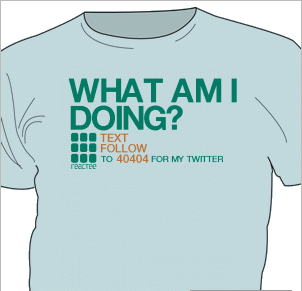
Twitter Shirt from igadget.com – $20

In the past 30-days, I’ve embarked on a challenge to see how and, most importantly, why I should integrate Twitter into my everyday life. That’s an easy discussion to have in your head, but how do you explain the benefits to your employees, friends and often times, confused family members? After 30 days, here’s my top five reasons for using Twitter:

  • It makes me really think about what I’m doing RIGHT NOW. Over the past year, I’ve become a student of personal productivity. Twitter requires me to consider if what I’m doing is Twitter worthy. If it’s not, I question whether it’s really worth my time.
  • It gives me “presence” with friends, coworkers, family and vendors. While I won’t say that it creates or sustains these relationships, it provides opportunity to build on them. Why? I can feedback, direct message or simply be aware of what’s going on in peoples lives.
  • It’s a great way to stay up-to-date with family. I’ve not been successful in converting many family members over to Twitter (yet), however, I am finding some luck by recently starting a Twitter for my 10-month old, @savannahgrace. Grandparents will do anything to stay in touch with their grandchild.
  • It’s marketable. Let’s be honest, I own an marketing company that focuses on internet, new and social media. I have to know how to use it, why it works for some and if and how to make it work for my clients.
  • It’s fun. I’m enjoying my new Twitter community of friends: @kristychowning, @savannahgrace, @ashbylane, @ashbychick, @michaelhyatt, @shawnrstewart. Recently joined? Follow me.

The internet is growing exponentially everyday. New social media can either be seen as a distraction or a tool. It’s up to us to consider why we use it to determine what place it will have in our lives. The key:

  • Commitment and plan on how you will use each tool
  • Integrate it into your life easily and then use it regularly
  • Have fun with it. If it’s not fun, you won’t use it.

If you find something cool, be sure to let me know.

Share and Enjoy

  • Facebook
  • Twitter
  • Delicious
  • LinkedIn
  • StumbleUpon
  • Add to favorites
  • Email
  • RSS

Gas is getting cheaper!

Perception has a way of creating value in ways that, when honestly assessed, don’t make a lot of sense:

  • A latte costs $32 a gallon, on average
  • A gallon of Smoothie King (Gladiator) smoothie costs $27.16/gallon (not including tax)
  • A cup of regular coffee costs $16/gallon, on average
  • It’s about $2/glass for soda at a restaurant, an average of $12.80/gallon
  • A gallon of Aquafina water could cost you at least $13.50, on average

The above list consists of items that most American’s consume on a daily basis, without thinking twice.

Last Wednesday, the Energy Department announced that they anticipate that the cost of a gallon of gas would rise to an average of $3.60 this coming June; an increase of 82¢ a gallon since this time last year.

I am not a proponent of rising fuel costs, especially since I personally can’t figure out what’s really driving this bottom line increase. However, I would like to challenge the perception. Auto fuel, an absolutely essential tool of our world, is far less expensive than any of the aforementioned nonessentials. All of which we could do without, if and when necessary.

Marketing departments have done a fantastic job at creating a high perceived value in our minds for packaged products. It seems that Exxon, Chevron, BP and the like, could stand to do some of their own marketing to win consumers over to their undervalued product. Until then, we’ll continue to live in a culture that values a gallon of coffee more than a gallon of gas.

Marketing influences. Perception pays the bills.

Share and Enjoy

  • Facebook
  • Twitter
  • Delicious
  • LinkedIn
  • StumbleUpon
  • Add to favorites
  • Email
  • RSS